


Imagine you are searching for the best digital marketing agency in India. Earlier, you would type that query into Google, scroll through 10 blue links, and visit two or three websites to compare. But things are changing, and it is changing fast.
Today, more and more people are directly asking ChatGPT, Perplexity, Google’s AI Overview, or Gemini for answers. And here’s the thing, these AI tools do not just rank websites. They read the web, extract the best information, and give you a ready-made answer. No clicks. No scrolling. Just an answer.
So what happens to your website if you’re not part of that answer?
You become invisible.
This is exactly why Generative Engine Optimization (GEO) has become one of the most important topics in digital marketing in 2026. And if you already understand SEO and AEO, then GEO is the next step in your digital marketing journey.
In this complete guide, we’ll break down:
- What GEO actually means (in plain, simple language)
- Why it matters in 2026 and beyond
- How it is different from SEO and AEO
- Step-by-step strategies to optimize for AI search engines
- A GEO checklist you can implement right now
Quick Summary: GEO stands for Generative Engine Optimization. It is the practice of optimizing your content so that AI-powered search engines like ChatGPT, Perplexity, Google AI Overviews, and Gemini include your content in their generated answers.
Table of Contents
1. What is GEO (Generative Engine Optimization)?
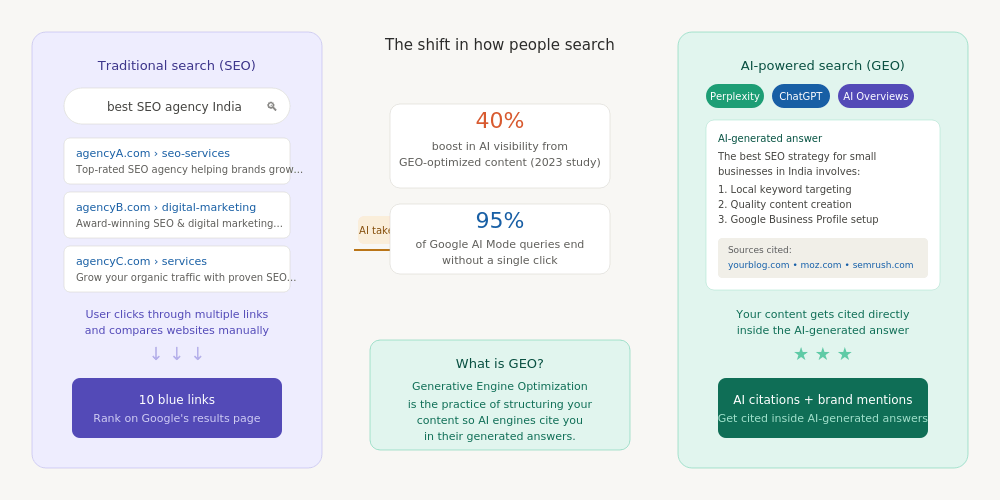
GEO, or Generative Engine Optimization, is the practice of creating and structuring your online content in a way that AI-powered answer engines choose your content when generating responses to user queries.
Let’s understand this with an example that’s close to home.
Say someone in Mumbai types into Perplexity AI: “Which is the best SEO strategy for small businesses in India in 2026?” Perplexity doesn’t just show a list of websites. It reads multiple articles from the internet, picks out the most useful, clear, and trustworthy information, and then writes a proper answer, almost like a knowledgeable friend explaining it to you.
Now, imagine your blog or website is one of the sources that Perplexity or ChatGPT used to write that answer. That’s GEO working in your favour.
In simple words: SEO helps you rank on Google. GEO helps you get cited and mentioned inside AI-generated answers.
The term GEO was first formally studied in research published in 2023, where researchers tested how different content strategies affected visibility in AI-generated responses from tools like BingChat and ChatGPT. The study found that specific content techniques could boost AI visibility by up to 40%, which is a massive opportunity for brands willing to adapt.
The Key Shift Happening Right Now
Here is what the data tells us about AI search adoption:
- ChatGPT crossed 100 million users faster than any app in history, and its weekly active user base continues to grow rapidly
- Google’s AI Overviews now appear for billions of searches every single month
- Early data suggests that for Google’s AI Mode, around 95 out of every 100 queries end without a user clicking any website
- For ChatGPT, between 78 to 99 queries out of 100 never send traffic to any website, but ChatGPT still sends 12 million clicks per month just in Germany alone
This means the traffic isn’t disappearing; it is concentrating. Fewer websites will get clicks, but those that do will get much higher-quality, intent-driven visitors. To be one of those websites, you need GEO.
2. How is GEO Different from SEO and AEO?
If you have read our earlier guides on What is SEO and SEO vs AEO, you already know that SEO and AEO, while related, serve different purposes. Now, let’s add GEO into that picture and compare all three clearly.
| Feature | SEO | AEO | GEO |
| Full Form | Search Engine Optimization | Answer Engine Optimization | Generative Engine Optimization |
| Goal | Rank on Google’s results page | Appear in featured snippets & voice answers | Be cited inside AI-generated answers |
| Platforms Targeted | Google, Bing, Yahoo | Google, Alexa, Siri, Cortana | ChatGPT, Perplexity, Gemini, Claude, AI Overviews |
| Content Format | Long-form blog posts, keywords | FAQs, direct Q&A answers | Structured, cited, extractable content |
| Primary Metric | Rankings, organic traffic | Featured snippet appearances | AI citations, brand mentions in AI answers |
| Backlinks Important? | Yes, very important | Moderately important | Yes, but unlinked mentions also count |
| Keyword Density Focus | Yes | Moderate | Less focus, answer clarity matters more |
Here’s the important thing to understand: SEO, AEO, and GEO are not enemies. They work together. Think of them as three layers of visibility in today’s search landscape:
SEO = Getting found on Google’s traditional search results page
AEO = Getting your answer shown directly in featured snippets and voice search
GEO = Getting your content cited and referenced inside AI-generated responses
A smart digital marketing strategy in 2026 needs all three.
3. How Do AI Search Engines Actually Work?
To understand GEO properly, you need to understand how these AI search tools like ChatGPT with web search, Perplexity, and Google’s AI Overviews actually find and use your content.
There are two main systems at work here.
System 1: Foundation Models (Training Data)
Tools like ChatGPT, Claude, and Gemini are built on what are called Large Language Models (LLMs). These models are trained on massive amounts of internet content such as books, articles, websites, and forums, up to a specific date (called the ‘knowledge cutoff’).
This training data is now fixed. The model has already learned from it. For most current AI models, it is too late to influence this training data directly.
However, your long-term brand presence on the internet, specifically how often your content is written about, referenced, and discussed on authoritative platforms, does influence future model training. So building your brand consistently matters.
System 2: RAG or Retrieval Augmented Generation (Your Real Opportunity)
This is where your immediate GEO efforts will have the biggest impact.
When a user asks ChatGPT a current question like ‘best SEO strategies in India 2026’, ChatGPT doesn’t just answer from memory. It performs live web searches, pulls in fresh content from real websites, reads it, and then generates an answer combining that fresh data with its training knowledge. This is called Retrieval Augmented Generation, or RAG.
Perplexity AI works almost entirely on RAG. Google’s AI Overviews also use a RAG-based approach.
Key Insight: RAG-based AI search is where you can make an immediate difference. By structuring your content correctly, you make it easy for AI systems to find, extract, and use your content in their answers.
How AI Systems Pick Their Sources
When an AI searches the web to answer a question, it doesn’t just grab the top-ranked Google result. It looks for content that is:
- Clear and directly answering a question
- Structured with proper headings, lists, and tables
- From authoritative and trusted sources (domain authority still matters)
- Recent and fresh (especially for news or time-sensitive topics)
- Cited on other platforms, meaning other websites reference or mention it
4. Why GEO Matters for Indian Businesses and Marketers
You might be thinking: is GEO really relevant for someone running a business in India? The answer is: absolutely yes, and sooner than you think.
The adoption of AI tools like ChatGPT and Perplexity is growing rapidly across India. Young professionals, students, and business owners are using these tools for research, product recommendations, and decision-making every single day.
A CA in Ahmedabad, a startup founder in Bengaluru, or an e-commerce seller in Delhi. All of them are increasingly asking AI tools for advice. If you’re a marketing agency, an education platform, a local business, or a blogger, GEO can directly help you:
- Get your brand mentioned in AI-generated answers when your potential customers ask relevant questions
- Build authority and trust, since being cited by AI tools positions you as an industry expert
- Drive high-intent traffic. Users who find you through AI search are already looking for exactly what you offer
- Stay ahead of competitors who haven’t started with GEO yet (the window is still open)
Early movers win big in GEO. The brands that optimize for AI search now will have a significant head start when AI search becomes the default for Indian internet users.
5. The 3 Pillars of GEO: What AI Search Engines Want
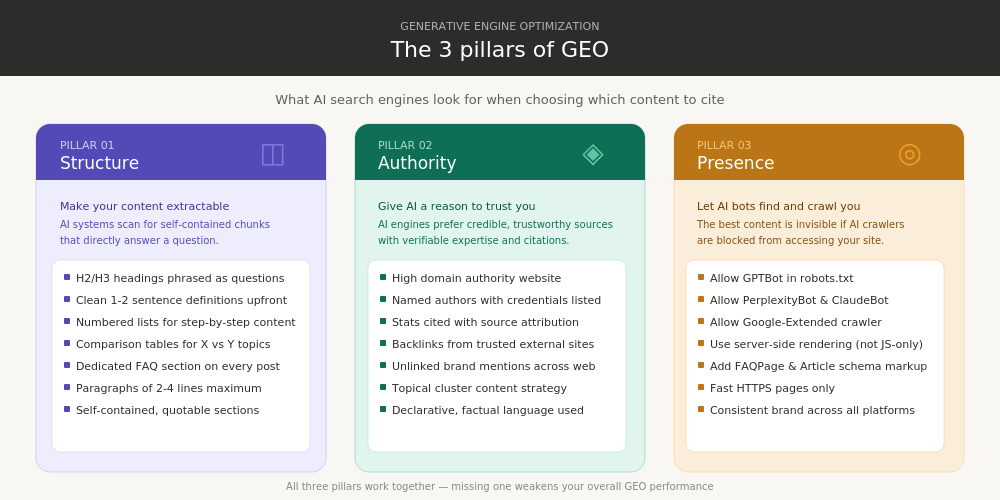
Based on research and real-world testing, GEO success comes down to three core pillars. Think of these as the foundation of your entire AI search strategy.
Pillar 1: Structure – Make Your Content Extractable
AI systems don’t read your entire article and then summarize it. They scan for specific, self-contained chunks of information that directly answer a question. If your content is buried inside long paragraphs with no clear structure, AI tools will skip past it.
Here’s what ‘structured content’ means in practice:
- Use clear H2 and H3 headings that are phrased as questions or direct statements
- Write tight definition blocks. When explaining a concept, give a clean 1-2 sentence definition at the start
- Use numbered lists for steps and processes (AI loves to extract step-by-step content)
- Use comparison tables for ‘X vs Y’ type questions
- Add a dedicated FAQ section at the bottom of every important blog post
- Keep paragraphs short, ideally 2 to 4 lines maximum
A good test: Can any section of your article be quoted alone, without reading the rest of the piece, and still make sense? If yes, it is well-structured for AI extraction.
Pillar 2: Authority – Give AI a Reason to Trust You
AI engines prefer content from credible, trustworthy sources. This is very similar to traditional SEO, but with some important nuances.
Authority signals for GEO include:
- Domain Authority: High-authority websites get preferential treatment from AI systems
- Named Authors with Credentials: Anonymous content performs worse than content from a named expert (e.g., ‘Written by Vijay Chauhan, SEO Specialist with 8 years of experience’)
- Citations and References: When your content cites reliable data sources (like Google, Semrush, or government data), it is seen as more credible
- Backlinks and External Mentions: Other sites linking to or mentioning your brand boosts your AI visibility
- Unlinked Brand Mentions: This is unique to AI search. Even when other websites mention your brand without linking to you, AI systems appear to give weight to this. It is like word-of-mouth for the AI world
Pillar 3: Presence – Let AI Bots Find You
This is the technical side of GEO. You might have the best content in the world, but if AI crawlers can’t access your website, none of it matters.
You need to check:
- Your robots.txt file: Make sure you are not accidentally blocking AI crawlers. Key bots to allow: GPTBot (ChatGPT), PerplexityBot (Perplexity), ClaudeBot (Anthropic/Claude), Google-Extended (Google AI)
- JavaScript rendering: If your content only appears after JavaScript loads, many AI bots can’t see it. Use server-side rendering for important content
- Page speed and HTTPS: Slow or insecure pages are skipped by AI crawlers, just like they are penalized in SEO
- Schema Markup: Adding structured data (like FAQPage, HowTo, Article schema) helps AI systems understand what type of content they are reading
To learn more about the technical side, check out our detailed guide on the Technical SEO Checklist for 2026, and many of those technical fixes directly help your GEO performance too.
6. GEO Strategies: How to Optimize Your Content for AI Search
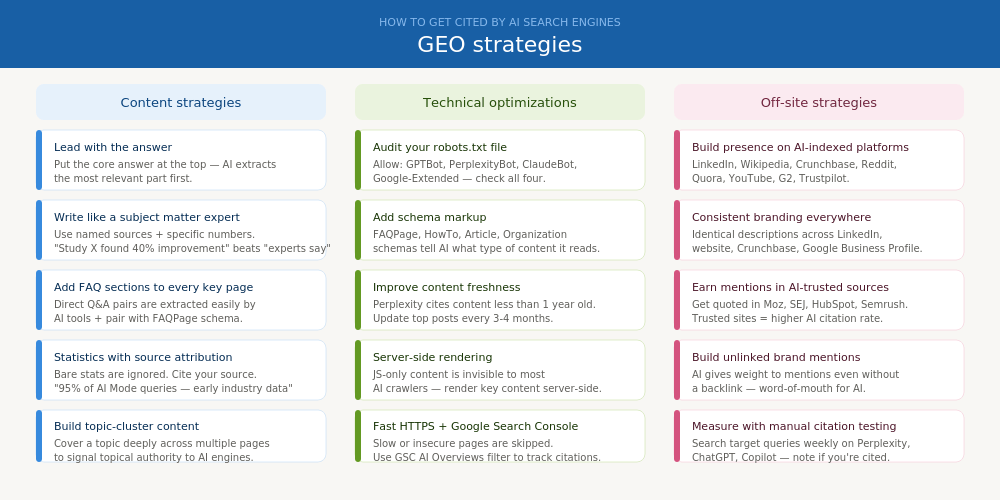
Now let’s get into the actual tactics. Here are the proven strategies to improve your GEO visibility, broken down into content, technical, and off-site approaches.
Content Strategy for GEO
Strategy 1: Lead with the Answer
In traditional SEO, many writers build up to the answer over several paragraphs. In GEO, you do the opposite. You put the core answer right at the top. AI systems extract the most relevant answer, and if it is buried 1,000 words into your article, it will be missed.
Strategy 2: Write Like a Subject Matter Expert
AI tools prefer authoritative, specific content. Instead of writing ‘experts believe GEO is important,’ write ‘According to research published in GEO: Generative Engine Optimization (2023), optimizing content with specific techniques improved AI engine visibility by up to 40%.’ Named sources, specific numbers, and precise claims get picked up by AI.
Strategy 3: Use Declarative, Factual Language
Avoid vague, opinion-heavy writing. Replace ‘We think this strategy works well’ with ‘This strategy increased AI citation rates by 30% in our testing.’ AI engines prefer content that reads like fact, not opinion.
Strategy 4: Add FAQ Sections to Every Important Page
FAQ sections are gold for GEO. When you write a direct Q&A, ‘What is GEO? GEO stands for Generative Engine Optimization. It is the practice of…’, AI tools extract these Q&A pairs very easily. You should also add FAQPage schema markup to make this even more powerful.
Strategy 5: Use Statistics with Source Attribution
Bare statistics without a source are ignored by AI. Instead of ‘AI search is growing fast,’ write ’95 out of 100 queries in Google’s AI Mode end without a click, according to early industry data.’ The attribution makes the stat citable.
Strategy 6: Create Comprehensive, Topic-Cluster Content
AI tools tend to cite websites that have deeply covered a topic, not those with one shallow article. Building a cluster of related content (as we have been doing on this blog with our SEO, AEO, and now GEO guides) signals topical authority to both traditional search engines and AI systems.
Technical GEO Optimizations
Step 1: Audit Your robots.txt File
Go to yourdomain.com/robots.txt and check whether any AI bots are blocked. Here is what your robots.txt should include to allow AI crawlers:
User-agent: GPTBot
Allow: /
User-agent: PerplexityBot
Allow: /
User-agent: ClaudeBot
Allow: /
User-agent: Google-Extended
Allow: /
Step 2: Add Schema Markup
Schema markup is structured data code that tells AI systems what your content is about. The most impactful schemas for GEO are:
- FAQPage schema, for FAQ sections
- HowTo schema, for step-by-step guides
- Article schema, for blog posts
- Organization schema, for your brand pages
You can validate your schema at schema.org/validator.
Step 3: Improve Content Freshness
Research shows that content cited by ChatGPT averages around 1,000 days old, while Perplexity tends to cite content that is less than a year old. This means regularly updating your existing content with new data, examples, and information is critical for GEO.
A practical habit: review and update your top blog posts every 3-4 months.
Off-Site GEO Strategies
Strategy 1: Build Your Brand Presence on AI-Indexed Platforms
AI engines don’t just read your website. They pull information from across the web. Key platforms where you should build a strong, consistent presence:
- Wikipedia (if applicable to your brand or industry)
- LinkedIn (company page and thought leadership articles)
- Crunchbase (for businesses and startups)
- Reddit and Quora (genuine helpful answers, not spam)
- YouTube (video descriptions and transcripts)
- G2, Trustpilot (for software and service businesses)
- Industry publications and news sites
Strategy 2: Maintain Brand Consistency Across All Platforms
This one is surprisingly powerful. AI systems build a picture of your brand from multiple sources. If your description, services, and messaging are inconsistent across LinkedIn, your website, Crunchbase, and Google Business Profile, AI gets a confused picture of who you are.
Keep your brand description identical or near-identical across all major platforms. Some businesses have seen ChatGPT visibility improvements within days of implementing consistent branding.
Strategy 3: Earn Mentions in AI-Trusted Sources
Think about which websites AI engines trust in your industry. For digital marketing, that might be Search Engine Journal, Semrush Blog, Moz, Neil Patel, or HubSpot. For tech, it might be TechCrunch or The Verge. Getting mentioned or quoted in these sources massively improves your AI citation rate.
7. How to Measure Your GEO Performance
Unlike traditional SEO where you can easily track rankings, GEO measurement is still evolving. But here are the practical ways to track your AI search visibility right now.
Method 1: Manual Citation Testing
This is the most reliable method available today. Once a week, search your target queries on:
- Perplexity.ai, check the ‘Sources’ panel on the right side
- ChatGPT with web search enabled, check the cited links
- Google with AI Overviews, check if your site appears
- Microsoft Copilot, check source cards
For each query, note: Were you cited? Where did you appear in the source list? What text was extracted from your site?
Method 2: Google Search Console for AI Overviews
Google Search Console now has a ‘Search type: AI Overviews’ filter. Use this to find:
- Which queries trigger AI Overview impressions for your site
- What click-through rates look like from AI Overview placements
- Which specific pages are being cited in AI Overviews
Method 3: Track AI Traffic in Google Analytics
AI search engines are starting to send referral traffic. Set up a custom segment in Google Analytics 4 that captures traffic from AI platforms. Look for traffic sources including ChatGPT, Perplexity, Claude, Gemini, and Copilot domains.
Method 4: Track Brand Mentions
Set up Google Alerts for your brand name and key product names. Unlinked brand mentions across the web, even without a backlink, contribute to your GEO visibility.
| What to Track | Tool to Use | Frequency |
| Perplexity citations | Manual query testing | Weekly |
| ChatGPT citations | Manual query testing | Weekly |
| Google AI Overviews | Google Search Console | Weekly |
| Copilot citations | Manual query testing | Monthly |
| AI bot crawl activity | Server logs / Cloudflare | Monthly |
| Competitor AI citations | Manual query testing | Monthly |
| Brand mentions | Google Alerts | Real-time |
8. GEO Checklist: 15 Things to Do Right Now
Use this checklist to immediately start improving your GEO visibility. Some of these overlap with good SEO and on-page SEO practices, because as we mentioned, GEO and SEO work together.
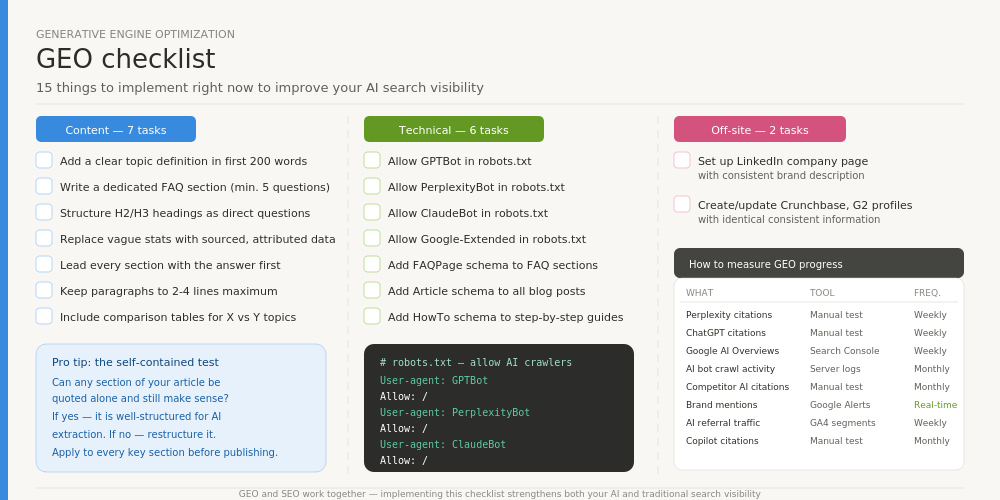
Content Checklist
- Add a clear definition of your main topic in the first 200 words of every key page
- Write a dedicated FAQ section on every important blog post (minimum 5 questions)
- Structure content with H2/H3 headings that read like questions
- Replace vague statistics with sourced, attributed data
- Lead every section with the conclusion, put the answer first, then explain
- Keep paragraphs to 2-4 lines maximum
- Include comparison tables for any ‘X vs Y’ topics
Technical Checklist
- Check robots.txt and ensure GPTBot, PerplexityBot, ClaudeBot, and Google-Extended are not blocked
- Add FAQPage schema to pages with FAQ sections
- Add Article schema to all blog posts
- Add HowTo schema to step-by-step guides
- Ensure key content renders without JavaScript (server-side rendering)
- Update old content with fresh data every 3-4 months
Off-Site Checklist
- Set up and complete LinkedIn company page with consistent brand description
- Create or update Crunchbase, G2, and other directory profiles with consistent information
9. GEO in 2026: What’s Coming Next
GEO is still a young field, but it’s evolving fast. Here are the key trends shaping GEO in 2026:
AI Mode is Becoming the Default
Google is aggressively expanding its AI Overviews feature globally. In many regions, AI-generated answers now appear for the majority of informational queries. This shift is happening faster in English-speaking markets but will spread to India rapidly.
Multimodal AI Search
AI search is no longer text-only. Tools like Google Lens and ChatGPT can now process images and videos. This means optimizing your images with descriptive alt text, captions, and file names, and potentially creating video content with keyword-rich transcripts, will become increasingly important for GEO.
AI Search Personalization
AI engines are beginning to personalize answers based on a user’s previous queries and preferences. This makes brand consistency and topical authority even more important, the more consistently you are associated with a specific topic across the internet, the more likely an AI will recommend you to users who search that topic.
Unlinked Mentions Will Matter More
Traditional SEO is built on backlinks, when another website links to yours. GEO appears to also give weight to unlinked brand mentions, when another website writes about you without linking to you. PR, brand awareness campaigns, and community participation (like genuinely helpful answers on Reddit or Quora) could become core GEO tactics.
Frequently Asked Questions About GEO
What does GEO stand for?
GEO stands for Generative Engine Optimization. It refers to the process of optimizing your content so that AI-powered search engines and chatbots like ChatGPT, Perplexity, and Google’s AI Overviews include your content in their generated answers.
Is GEO replacing SEO?
No, GEO is not replacing SEO, it is an addition to it. Traditional SEO gets you ranked on Google’s results page. GEO gets you cited inside AI-generated answers. Both are important, and the strategies overlap significantly. Think of GEO as the next evolution of SEO, not a replacement.
Do I need to learn completely new skills for GEO?
Not entirely. If you have been doing solid SEO, creating high-quality content, building backlinks, and maintaining good technical hygiene, you are already most of the way there for GEO. The key additional skills are content structuring for AI extraction, schema markup, and brand presence management across AI-indexed platforms.
How long does it take to see GEO results?
GEO results can appear much faster than traditional SEO. Some businesses have reported appearing in Perplexity or ChatGPT citations within days of making structural and brand consistency improvements. However, consistent results require ongoing effort over weeks and months.
Is GEO useful for small businesses in India?
Absolutely. In fact, GEO can be a great equalizer for small businesses. AI search doesn’t just favor the biggest brands, it favors the clearest, most authoritative, and best-structured content. A well-optimized small business blog can appear in AI answers alongside major competitors.
What is the difference between AEO and GEO?
AEO (Answer Engine Optimization) focuses on appearing in featured snippets and voice search results on traditional platforms like Google. GEO focuses specifically on AI-generated answers from tools like ChatGPT, Perplexity, Gemini, and Claude. Our detailed comparison guide on SEO vs AEO covers AEO in depth.
Conclusion: GEO is the Future, Start Now
We are living through one of the biggest shifts in how people search for information online. AI-powered tools are not just a trend, they are becoming the default way that people discover products, services, and information.
GEO is how you make sure your brand is part of that conversation.
The good news? You don’t need to abandon everything you’ve built with SEO. You need to evolve it. Start by auditing your content for extractability, adding schema markup, ensuring AI bots can access your site, and building your brand presence on platforms that AI engines trust.
The brands that act now will have a significant head start. The window of opportunity to establish GEO authority is still open, but it won’t stay open forever.
